What 70 Million Google Maps Views Reveal About the Long-Term Value of Virtual Tours
November 16, 2026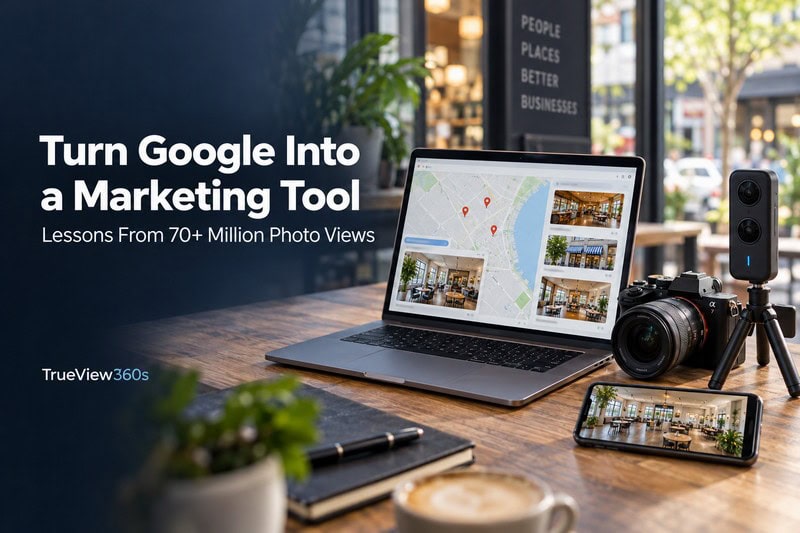
Google has changed dramatically over the years, but one thing hasn’t changed: when people need a product, service, professional, restaurant, office, contractor, or almost anything else, Google is often one of the first places they look.
That makes Google much more than a search engine. For a business, it can be one of the most powerful marketing tools available.
I have seen that firsthand.
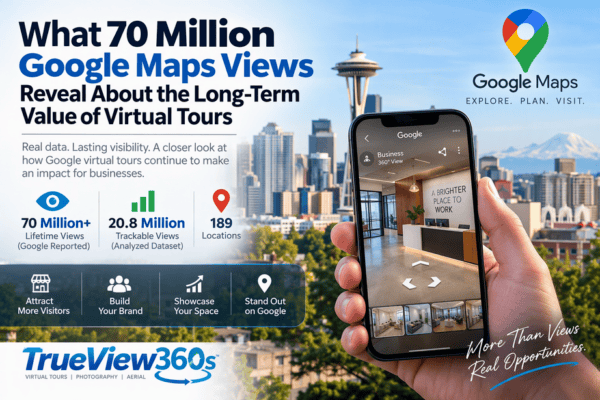
Through my work with TrueView360s and years of photography, virtual tours, and Google Maps contributions, the photos I have published on Google have generated more than 70 million views.
That did not happen because of one advertising campaign or one perfectly optimized website.
It happened over time by consistently giving Google useful information and, more importantly, giving the people using Google the information they were looking for.
That distinction is important.
Too many businesses think about Google marketing exclusively in terms of ranking number one for a keyword. Rankings matter, but Google marketing today is much broader than traditional search engine optimization.
Your website, Google Business Profile, reviews, photos, virtual tours, Maps presence, and the information Google can understand about your business all contribute to how easily customers can find and evaluate you.
Here are some of the biggest lessons I have learned.
How Are Your Customers Actually Searching for Your Business?
One of the most common marketing mistakes is thinking like the business instead of thinking like the customer.
You may describe your company one way internally, while prospective customers use completely different terminology when searching Google.
For example, someone looking for office space might search for:
- Office space for rent near me
- Small office space
- Executive suites
- Flexible office space
- Furnished office space
- Office space in a specific city
- How much office space do I need?
- How much does it cost to rent an office?
Those searches represent different points in the decision-making process.
Some people are ready to contact someone immediately. Others are still trying to understand their options.
A strong Google marketing strategy addresses both.
Your service and location pages can target people who are ready to buy, while useful articles, FAQs, guides, photos, and other resources can reach people earlier in their research.
Instead of asking, “What do I want to rank for?”, ask:
“What questions are my prospective customers asking Google?”
Then provide the best answer you can.
Why Is Your Google Business Profile So Important?
For many local businesses, a Google Business Profile may be one of the first things a prospective customer sees.
Someone researching your company may see your business information, reviews, photographs, location, and other information before ever visiting your website.
Google recommends maintaining accurate business information, adding photos and videos, and collecting and responding to reviews through your Google Business Profile.
That makes accuracy important.
Pay particular attention to your:
- Business name
- Primary and secondary categories
- Address or service area
- Phone number
- Website
- Hours
- Business description
- Services
- Photos
- Reviews
Don’t create a profile and forget about it.
Businesses change. Hours change. Services change. Photographs eventually become outdated. Competitors improve their profiles.
Periodically search for your own business and look at what a prospective customer sees.
If you knew nothing about your company, would what you see on Google make you want to contact it?
Why Are Professional Photos So Important to Google Marketing?
This is an area where my own experience has particularly changed the way I look at Google.
Business owners frequently underestimate photography. They’ll spend significant money building a location, remodeling an office, developing a website, or establishing a brand, and then represent all of that online with a handful of mediocre photographs.
That is a mistake.
People want to see what they’re considering.
A potential customer looking at a restaurant wants to see the dining room and food. Someone considering a hotel wants to see the rooms. A prospective office tenant wants to see the space. A customer considering a retailer wants to know what the store looks like.
Good photographs reduce uncertainty.
That’s why we put so much emphasis on professional virtual tours and property photography.
Google Maps can make those images particularly powerful because people encounter them while they’re actively researching businesses or locations.
My experience generating more than 70 million Google views reinforced something I now believe strongly:
Useful visual content can keep working for years.
A photograph uploaded today isn’t necessarily a one-week social media post that disappears down a feed. If people continue to find it useful, it can remain part of your digital presence long after it was originally published.
That gives quality photography a surprisingly long marketing life.
How Can You Let Customers See Inside Your Business Before They Visit?
Still photographs answer many questions, but immersive 360-degree imagery can go further.
A Google Virtual Tour for your business allows prospective customers to explore a location online before making an in-person visit.
This can be particularly valuable for:
- Restaurants
- Hotels
- Medical and dental offices
- Retail stores
- Fitness centers
- Event venues
- Commercial properties
- Office spaces
Think about the customer’s perspective.
They may want to understand the size of the location, atmosphere, layout, entrance, waiting area, amenities, or general appearance before deciding whether to visit.
An interactive virtual tour gives them another layer of information.
Unlike conventional video, interactive 360-degree tours also allow viewers to choose where they want to look and move through the property at their own pace.
The objective isn’t simply to impress people with technology.
It is to remove uncertainty from the buying decision.
That’s an important principle that applies to almost every form of digital marketing.
How Do Online Reviews Help Market Your Business?
You can say your company provides excellent service.
A customer saying it is usually more persuasive.
Google reviews can provide valuable social proof when someone is deciding among several businesses.
Businesses should therefore have a simple, consistent process for asking satisfied customers to leave honest reviews.
Don’t wait until you desperately need them.
And don’t focus exclusively on the star rating.
Read what customers actually say.
Reviews can tell you what people value most about your business. They can also expose problems you might not otherwise notice.
When possible, respond professionally to reviews, including negative ones.
Remember that your response isn’t only for the person who wrote the review.
Future customers may read it too.
Why Does Your Website Still Matter?
With all the attention given to Google Business Profiles, Maps, reviews, photos, virtual tours, and AI, it is easy to underestimate the website.
That would be a mistake.
Your website is one of the few digital properties your business controls.
It should clearly explain:
- Who you are
- What you do
- Where you work
- Who you help
- Why someone should choose you
- How to contact you
It should also work well on a phone and load quickly.
Fancy design doesn’t compensate for a confusing website.
When someone arrives from Google, they should understand what you do within seconds.
And don’t make visitors hunt for your phone number, contact form, location, or next step.
TrueView360s, for example, presents its services around 360-degree virtual tours and professional property photography, helping visitors quickly understand the visual marketing services we provide.
Why Should You Answer Real Customer Questions on Your Website?
Every business hears questions repeatedly.
Write them down.
Those questions are potential articles.
For TrueView360s, for example, potential customers may want to know:
- What is a virtual tour?
- How long does creating a virtual tour take?
- What kinds of businesses benefit from virtual tours?
- How are Google Virtual Tours different from other virtual tours?
Those are useful questions because they’re questions real prospects have.
We use this approach in the TrueView360s virtual tour FAQ, where visitors can find answers to common questions about virtual tours and the services involved.
Instead of publishing generic articles simply because a keyword tool says they attract traffic, build a library that genuinely helps your customer make better decisions.
This approach also closely follows Google’s own guidance. Google Search Central recommends creating helpful, reliable, people-first content rather than content created primarily to manipulate search rankings. Google also recommends providing original information or analysis and demonstrating first-hand expertise.
For TrueView360s, that means using our actual experience with Google photography, virtual tours, real estate photography, and millions of Google photo views to answer questions potential customers really have.
Should You Pay Attention to the Technical Side of Google?
Absolutely.
Great content won’t perform as well as it should if the website behind it is painfully slow or difficult for Google to crawl.
This doesn’t mean every business owner needs to become a programmer.
It does mean you should periodically check the basics:
- Mobile usability
- Page speed
- Core Web Vitals
- Broken links
- Indexing
- Page titles
- Meta descriptions
- Image sizes
- Internal links
- XML sitemaps
- HTTPS security
Google Search Console is particularly useful because it lets you see your website more from Google’s perspective.
Google Analytics can then help you understand what visitors do after reaching your site.
The goal isn’t collecting more reports.
The goal is finding opportunities and problems you can actually act on.
Can Google Marketing Become a Long-Term Business Asset?
I believe it can, and this may be the most important lesson I’ve learned.
A Google presence can compound over time.
One useful article may bring a small number of visitors.
One good photograph may attract a few views.
One review may influence one prospective customer.
None seems earth-shattering by itself.
But imagine a business with hundreds of helpful pages, strong location information, hundreds of legitimate reviews, professional imagery, useful videos, virtual tours, accurate business information, and years of history.
Each piece reinforces the others.
That is why I don’t think businesses should treat Google exclusively as an advertising channel.
Advertising usually stops producing traffic when you stop paying.
A useful article, photograph, review, business listing, or virtual tour can potentially remain discoverable long after the original work was done.
I have seen that happen firsthand.
Those 70+ million views weren’t generated overnight. They accumulated because useful visual information remained available where people were looking for it.
Should You Try to Outsmart Google?
I wouldn’t build a long-term marketing strategy around it.
SEO has always attracted shortcuts.
Businesses have chased keywords, backlinks, formulas, and whatever technique seemed likely to move them higher in the rankings.
Some techniques work temporarily.
Others create more problems than they solve.
A much more durable strategy is surprisingly simple:
Help the person conducting the search.
If someone wants to know what your business looks like, show them.
If they want to know what your service costs, explain what determines the price.
If they have a common question, answer it.
If they’re comparing alternatives, explain the differences honestly.
If they’re looking for your location, make it easy to find.
If they need reassurance before contacting you, provide reviews, photographs, examples, and evidence.
For people who want to understand the technology before deciding whether it’s appropriate for their business, our 360-degree virtual tour services overview explains more about the interactive tour experience.
Google’s technology will continue changing.
The underlying customer need probably won’t.
How Can You Perform a Quick Google Marketing Checkup?
If you own or manage a business, take 15 minutes and search for it the same way a prospective customer would.
Don’t just type the company name.
Search for the service you provide and the geographic area you serve.
Then ask yourself:
- Can I easily find my business?
- Is my Google Business Profile information accurate?
- Are my best services obvious?
- Are my photographs current and professional?
- Do I have recent customer reviews?
- Does my business appear credible?
- Is my website fast and mobile-friendly?
- Can visitors immediately tell what I do?
- Does my website answer the questions customers actually ask?
- Is there an obvious way to contact me?
You may be surprised by what you find.
Better yet, ask someone who doesn’t work for your company to perform the same exercise. They may notice problems that you’ve learned to overlook.
Is Your Next Customer Already Searching for What You Offer?
That’s the great opportunity with Google.
In many cases, you don’t have to create demand from nothing.
Someone is already searching.
They’re searching for a photographer.
An office.
A restaurant.
A contractor.
A consultant.
A dentist.
A hotel.
A property.
Or an answer to a problem.
The question is whether your business will be there when they search.
After years of working with Google, websites, photography, virtual tours, Maps, and online marketing, that’s the lesson I keep coming back to.
You don’t need to master every new marketing trend.
You need to make it easy for Google and prospective customers to understand who you are, what you do, where you do it, and why someone searching for your service should trust you.
Then give the person on the other side of that search genuinely useful information.
Do that consistently, and Google stops being simply a place where your company appears.
It becomes a marketing asset that can continue working for your business day after day, year after year.
For more information about how we use professional photography and immersive imagery to help businesses and properties get seen online, learn more about TrueView360s and our approach to virtual tours, photography, and Google Maps.