

How to Make Your Business Instantly More Trustworthy Online
October 8, 2026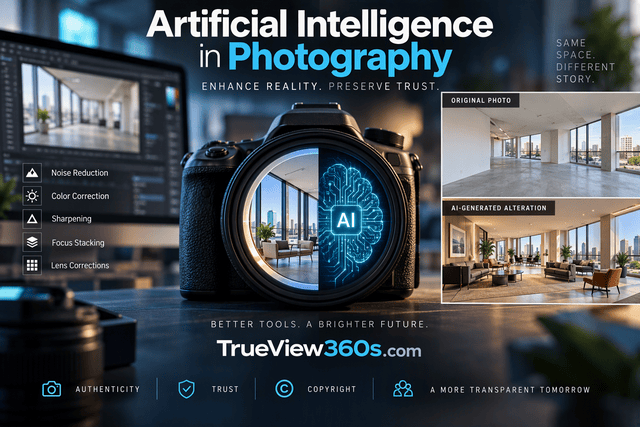
AI photography tools can reduce noise, sharpen details, correct exposure, identify subjects, improve focus, and complete editing tasks in seconds that once required considerable time and technical skill.
But artificial intelligence can also do something fundamentally different:
It can create a reality that never existed.
That ability is creating an ethical crisis surrounding authenticity, trust, and copyright in photography.
The central question isn’t whether photographers should use AI. Artificial intelligence is already becoming part of modern photography workflows.
The more important question is:
Where is the line between improving a photograph and fabricating one?
For commercial real estate photography, business photography, and 360° virtual tours, that distinction matters most. People viewing these images aren’t simply looking for attractive pictures. They may depend on them to understand what a real property or business actually looks like.
What Is AI in Photography?
AI in photography refers to using artificial intelligence technologies to help create, process, enhance, or modify photographic images.
But not every use of AI is the same.
A major ethical difference exists between assistive AI that improves information captured by a camera and generative AI that creates or substantially alters visual information.
Assistive AI enhances what the camera saw. Generative AI can create what the camera never saw.
This distinction may ultimately be more useful than simply labeling an image as “AI edited.”
Assistive AI: The Modern Digital Darkroom
Photography has never required photographers to publish an image exactly as it came out of the camera.
Film photographers selected film stocks, adjusted exposure, dodged and burned prints, and made creative decisions in the darkroom.
The transition to digital photography brought RAW processing, Photoshop, Lightroom, HDR, automatic lens corrections, and increasingly sophisticated color adjustments.
AI-assisted photo editing is in many ways the next evolution of that process.
Examples of Assistive AI in Photography
- AI noise reduction
- Image sharpening
- Focus stacking
- Exposure adjustments
- White-balance correction
- Lens corrections
- Subject detection
- Perspective correction
- Panorama stitching
- Color correction
- Basic retouching
- Automated masking
These tools can help photographers improve the information actually captured by a camera.
This makes assistive AI comparable to a highly advanced digital darkroom. AI may make the photographer more efficient, but the underlying photograph still represents a real subject captured by a camera.
When Does AI Photo Editing Become Generative AI?
Generative AI crosses a much more significant line.
Instead of telling software to improve information captured by a camera, the photographer can ask the software to create new visual information.
Imagine photographing an office available for lease. Generative AI could create an altered image showing features that weren’t present when the photograph was taken.
For example:
- Adding furniture that wasn’t there
- Replacing flooring or finishes
- Changing the view through a window
- Adding landscaping
- Removing permanent architectural elements
- Creating additional visual space
- Generating decorative features
The finished image might look spectacular.
But does it accurately represent the property being photographed?
For commercial real estate photography, that question matters.
A prospective tenant looking at photographs of an available office isn’t merely seeking artistic inspiration. They’re trying to understand the actual property.
The same applies to consumers viewing photographs of restaurants, retail stores, hotels, medical offices, and other businesses.
AI Photography: Editing vs. Misrepresentation
The ethical issue isn’t simply whether an image has been edited. Professional photographers have edited photographs for generations.
The important distinction is whether those edits help communicate the photographed subject or materially change what the viewer believes existed.
Correcting White Balance vs. Changing a Room
Correcting inaccurate white balance so an office’s walls appear closer to their real color can improve the photograph’s representation of the space.
Changing those walls into floor-to-ceiling windows creates a substantially different scene.
Brightening a Photograph vs. Generating Objects
Adjusting an underexposed photograph can reveal details the camera captured.
Generating high-end furniture that was never present introduces new content.
Correcting Lens Distortion vs. Creating More Space
Correcting lens distortion can improve the way a room is represented.
Artificially extending the room creates space that wasn’t photographed.
This leads to a practical ethical test for professional photographers.
Could this edit cause someone to believe the camera captured something that wasn’t actually there?
That question puts authenticity at the center of the decision.
Why AI Creates an Authenticity Problem for Photography
Photography has traditionally carried a straightforward implication: the object, person, or place shown in the image existed in front of a camera.
That doesn’t mean photography has ever been perfectly objective. A photographer chooses the camera, lens, composition, lighting, angle, exposure, and the exact moment to press the shutter.
Generative AI introduces something fundamentally different.
It lets realistic-looking visual information be created without ever passing through the camera.
At the extreme, a photorealistic AI-generated image can depict a scene that was never photographed.
That threatens something enormously valuable to photography:
Trust.
When people can no longer easily determine whether an image was captured, enhanced, or generated, the traditional credibility associated with photography becomes harder to maintain.
Why Authenticity Matters for Real Estate Photography
Authenticity matters especially in commercial and real estate photography.
Property photographs have a practical purpose. Potential buyers, tenants, and visitors use photography to form an initial understanding of a physical location before visiting.
Beautiful photography helps a property make a strong first impression.
But beautiful imagery and accurate imagery don’t have to be opposing goals.
Professional lighting, thoughtful composition, careful camera positioning, appropriate lenses, and skilled post-production can make a property look excellent while still showing viewers the real space.
The goal should be to present reality at its best, not replace it with something fabricated.
Artificial Intelligence and 360° Virtual Tours
The authenticity question becomes even more significant with 360° virtual tours.
A traditional photograph shows the viewer a selected perspective. A 360° tour provides a highly immersive understanding of the surrounding environment.
A commercial property tour lets prospective tenants explore an office before deciding whether to visit in person. A virtual tour of a business can similarly help potential customers familiarize themselves with a location.
AI can be useful within this workflow when it assists with appropriate technical tasks.
But generative changes to major elements of the environment can conflict with one of the basic reasons for creating a virtual tour:
To show people the actual space.
At TrueView360s, we believe technology should help people experience real places online, not leave them wondering whether those places are real.
AI-Generated Images and Copyright
Authenticity is only one part of the AI photography debate.
Copyright is another.
The rapid development of generative AI has raised questions concerning copyright, ownership, human creative contribution, and the use of copyrighted works in training AI models.
For professional photographers and businesses commissioning photography, generative AI poses important questions:
- What did the photographer actually create?
- What portions of the finished work were generated by AI?
- How much human creative control went into the work?
- How should commercial photography projects handle AI-generated material?
These issues make it increasingly important for photographers and businesses to understand the difference between traditional photographic work, AI-assisted editing and substantially generated imagery.
Should Photographers Disclose the Use of AI?
A useful principle is that not all AI usage deserves the same treatment.
Using AI to reduce image noise isn’t the same as generating grass that never existed.
Automatically masking a subject isn’t the same as replacing the subject.
That means a blanket statement like “AI was used” may not tell viewers much.
A better question is:
Was AI used to process captured information, or to create important visual information that wasn’t captured?
When generative AI materially changes an image intended to represent an actual property, business or location, transparency becomes much more important.
How Can Professional Photographers Use AI Responsibly?
The photography industry doesn’t need to reject artificial intelligence.
AI-assisted photography offers real advantages. AI has the ability to streamline repetitive editing tasks and help photographers get more from the photographic information they capture.
Instead, photographers need a clear ethical boundary.
For photography intended to document a real business, property or physical environment, use this principle:
Use AI to improve how reality is presented, not to secretly replace it.
That balance lets photographers benefit from new technology without sacrificing the trust that gives photography its value.
If AI imagery is intentionally used for visualization, concepts, artistic work, or design, clearly identifying its nature can help viewers understand they’re seeing a visualization rather than documentary photography.
Will AI Replace Professional Photographers?
AI may actually strengthen the value of one thing software cannot substitute for in documentary property photography:
Being there to photograph the real place.
Professional photography requires much more than pressing a shutter button.
A photographer makes decisions about:
- Camera position
- Lens selection
- Lighting
- Perspective
- Composition
- Timing
- Important property details
- The overall visual presentation
And above all, the photographer witnessed and captured a real environment.
AI can help process those photographs, speed up parts of the workflow, and provide increasingly sophisticated editing tools.
But efficiency and genuineness do not have to be enemies.
Human assessment + real photography + responsible AI assistance.
In the Age of AI, Authenticity Could Become Photography’s Greatest Asset
For decades, advances in digital imaging made it increasingly easy to create sharper, cleaner and more visually impressive photographs.
Generative AI changes the challenge.
Creating a spectacular-looking image is becoming easier. Establishing that an image authentically represents reality may become more valuable.
That distinction matters most for real estate photography, commercial photography, and 360° virtual tours.
People looking at these images aren’t simply searching for something attractive.
They’re trying to understand a real place before they go there.
Artificial intelligence can be an extraordinary assistant. It can improve workflows, enhance captured imagery and give professional photographers powerful new tools.
But there should remain a meaningful boundary between enhancing what the camera captured and inventing what the camera never saw.
Generative AI is an exciting creative medium. Photography is an extraordinary way to document the real world.
We don’t need to confuse the two.
For professional photography in the age of artificial intelligence, one of the most valuable promises may ultimately be the simplest:
This is what was really there.
Frequently Asked Questions About AI in Photography
What is AI photography?
AI photography generally refers to using artificial intelligence to create, process, enhance, or modify photographic images. AI can serve as an editing assistant, while generative AI can also create visual information that was never taken by a camera.
Is using AI to edit photos ethical?
It depends on how you use AI and the purpose of the photograph. Using AI for technical improvements, for example noise reduction, differs greatly from using generative tools to add or remove significant elements in a photograph meant to represent a real property or place.
What is the difference between AI-assisted and generative photography?
AI-assisted editing primarily works with photographic information already captured. Generative AI can produce new visual information, including objects, backgrounds or complete photorealistic scenes.
Can AI be applied in real estate photography?
AI can assist photographers with technical editing and workflow tasks. For photographs intended to represent real properties, substantial generative alterations can create authenticity concerns if viewers could reasonably mistake generated features for actual property features.
Will AI replace real estate photographers?
AI can automate parts of image processing, but photographing an actual property still requires decisions about camera position, composition, perspective, lighting, lenses, and how the physical space is represented.


